Friday, 25 February 2011

VII THE PARANORMAL IN VICTORIAN LITERATURE: GEORGE ELIOT 'THE LIFTED VEIL'

THE DANGERS INVOLVED IN LIFTING THE VEIL

In my earlier Posts my aim was to show that the practices associated with the Paranormal were attempts to explore the limits of Human Consciousness by lifting a number of Veils shrouding the Human Personality.

In this Post I shall examine how George Eliot explores the subject of revealing the potential of the Human Personality and the Human Mind in one of her lesser known stories, “The Lifted Veil” (1859). She does so in order to deliver A WARNING.


GEORGE ELIOT IN 1860. WHEN SHE WAS 41 YEARS OLD

George Eliot was well acquainted with each aspect of the Paranormal that I have discussed previously. She refers to PHRENOLOGY many times in her letters written between 1838 – 1840, to her friends Maria Lewis and Martha Jackson. More than that she became deeply involved in PHRENOLOGY especially after meeting the Coventry Ribbon Manufacturer, Charles Bray in 1841. She became a personal friend of Edmund Gurney (a member of the SPR) and of of George Combe (the disciple of Spurzheim), and no doubt under Combe’s influence began making PHRENOLOGICAL OBSERVATIONS of others, including Charles Dickens. She was rather disappointed at detecting nothing remarkable about this famous author.


CHARLES DICKENS IN 1867/8. GEORGE ELIOT NOTICED NOTHING REMARKABLE ABOUT HIM  PHRENOLOGICALLY ,

As for MESMERISM, she was well acquainted with this also. In 1844 she was herself MESMERISED at a Dinner Party. In addition she became involved in SPIRITUALISM, as her letters between 1840 and 1870 reveal. However, she was at times intensely hostile to this Paranormal practice. In fact she refused to sit in the same room as D.D. Home. But here is the paradox. Despite her aversion to Spiritualism, she thought it worthy of investigation.

In 1873 we notice a shift in George Eliot’s attitude once she met Edmund Gurney. It is highly likely that George Eliot based the character of Daniel Deronda, to some extent, on Gurney. Finally, she admitted to George Cross that her best writing occurred when something seemed to be TAKING POSSESSION of her. When this took place she felt like a mere INSTRUMENT through whom some sort of SPIRIT was operating. But students of George Eliot  detect A CERTAIN UNEASE concerning the Paranormal. The Novel, which we shall examine, makes that UNEASE apparent.

“The Lifted Veil” (1859) is a clear indication of that concern, and the background to the story reveals the fascination yet repulsion for the Paranormal on the author’s part. Although the story was written in 1859 it was only in 1873 that she allowed it to be included amongst her complete works. It appears that during this fourteen-year period her mind wavered as to its suitability.

OK let me outline the Story then you will not get lost. Don’t forget, though, there is no substitute for reading the Novel itself.

The story is narrated in the first person by a man named Latimer. He is  gifted or cursed with the Paranormal ability to discern the future and read the thoughts of other people. Unfortunately, Latimer recoils from what he sees about the motivations of others. It must be said that none of his predictions work out exactly as he foresaw them.  As the novel progresses, Latimer becomes entranced by his brother’s fiancĂ©e, Bertha, a cold- hearted flirtatious woman. She fascinates him because hers is the only mind he cannot read. When his brother dies Latimer marries Bertha. But the marriage disintegrates  as Bertha’s manipulative and untrustworthy nature become apparent. In true Gothic style. Bertha’s maid dies and a blood transfusion is administered to save her. The maid comes back to life briefly and accuses Bertha of a plot to poison Latimer. When this is revealed Bertha flees and Latimer eventually dies as he had foretold at the start of the novel.

 
THIS PICTURE CAPTURES THE ALOOF NATURE OF BERTHA TOWARDS LATIMER. NOTICE THE EYES, THE MOUTH, AND THE STANCE

The opening paragraph of the story reveals George Eliot’s aversion to the Paranormal. Latimer foresees the time and manner of his own death:

“Just a month from this day … I shall be sitting in this chair, in this study …longing to die, weary of incessant INSIGHT and FORESIGHT … without hope “ (Ch. 1)

Latimer is completely broken in spirit. There is nothing positive in his statement at all. Everything is wearisome. Notice how he focuses on ‘INSIGHT’ and on ‘FORESIGHT’ as twin CURSES. The story goes on to show, that as the VEILS lift one by one from his Mind, Latimer eventually reaches this desperate state. One after the other George Eliot brings out certain Paranormal techniques or abilities and points out the dire consequences – AS SHE SEES IT.

A PHRENOLOGIST soon comes on the scene
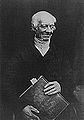
 

GEORGE COMBE THE PHRENOLOGIST TYPICAL OF THE ONE LATIMER’S FATHER ENGAGED TO DIAGNOSE HIS SON
  
Latimer tells us that in his early youth his father engaged Mr Letherall, a PHRENOLOGIST, to advise him on Latimer’s future career. Look how Mr Letherall proceeds. He takes Latimer’s ‘small head between his large hands and pressed it here and there in an exploratory, suspicious manner’  Following this he places ‘each of his great thumbs on my temples’ and studies the CONTOURS of  Latimer’s head.

After this examination Letherall launches into his interpretation and tells Latimer’s father what course of study the boy must undertake. The PHRENOLOGIST says, “the DEFICIENCY is there sir – there and here. Pointing to the alleged PHRENOLOGICAL CONTOURS he says, “here is the excess. That must be brought out, sir and this must be laid to sleep.’ Following this diagnosis his father engaged a range of private tutors because, ‘Natural History, Science, and the Modern Languages’ were the instruments for REORGANISING Latimer, mentally.


 AN EXAMPLE OF VICTORIAN HOME SCHOOLING SIMILAR TO THAT ADVOCATED FOR LATIMER

As we read on we discover that this study programme is irksome to this sensitive, artistic boy. Because this regime initiates Latimer’s mental trouble, George Eliot ATTACKS IT at once. This episode unquestionably reflects the VICTORIAN ASSUMPTIONS that one’s potential is determined at birth and by using the so called Scientific Method – in this case PHRENOLOGY – the Veil which shrouded one’s full potential could be lifted.

There are other points that must also be made. The implication is that these latent abilities could be MODIFIED: some could be ENHANCED and others SUPPRESSED exactly as Combe believed. Also the stress on particular features of Latimer’s training programme line up with Victorian PHRENOLOGICAL views on education.


GENEVA AT THE TIME OF LATIMER’S ILLNESS

Latimer’s mental trouble begins when he is sixteen years old and living in Geneva. At this time he suffers a severe illness directly traceable to the PRESCRIBED educational regimen. To remedy the situation Latimer’s father arranges a trip through various European cities concluding with a visit to Prague.


LATIMER HAS A MESMERIC VISION OF PRAGUE

After Latimer’s father has outlined the plans for his son’s recovery his father leaves the room. At that point,  Latimer experiences ‘a strange sense that a new and wondrous scene was breaking in upon me.’ He is engulfed by a MESMERIC TRANCE, in which he has a PREVISION of certain areas of Prague.

After Latimer comes out of the MESMERIC STATE, he  questions ‘whether  I had been sleeping. Was this a dream?’ He soon discounts this idea because he ‘remembered distinctly the gradual BREAKING IN of the VISION.’ He likens himself to a MESMERIC SUBJECT when he describes the ‘rapt passivity’ of the experience. (chap. I)

Now let us pause a moment or two and see what George Eliot is setting up. First she sets up the idea that the CLAIRVOYANT VISIONS seem fairly pleasant and harmless. After all, the VEIL lifts INVOLUNTARILY  from Latimer’s mind; it enables minute CLAIRVOYANT details of Prague to be seen. When Latimer eventually visits the City the details of his vision are corroborated precisely. No, Latimer does not at this stage appear to experience any ill effects at all. In relation to his visit to Prague, George Eliot deliberately provides Latimer with a basis for CONFIDENCE in what he had seen CLAIRVOYANTLY. So far, so good!

Several days later the VEIL over Latimer’s Mind begins to lift again, shifting its emphasis from places to people. A MESMERIC VISION arises  of a group of three people – none of whom are in the room. These include Latimer’s father, Mrs Filmore – note her dress – ‘a commonplace middle-aged woman in silk and cashmere’, and another lady ‘not more than twenty.’ She is a ‘tall, slim, willowy figure, with luxuriant blond hair, arranged in cunning braids and folds.’ The dominant imagery concerns her FACE and EYES. She is ‘thin-lipped .. the face had not a girlish expression: the features were sharp, the pale grey eyes at once acute, restless, and sarcastic.’ The eyes are ‘fixed on me in half-smiling curiosity.’


THE WOMAN IN THE VISION FIXES HER GAZE ON LATIMER

But then something strange occurs. Because of this woman’s physical appearance and the penetrating POWER OF HER EYES, Latimer feels, ‘a painful sensation as if a sharp wind were cutting me’ His father – in the vision – makes a final remark, “Well, Latimer, you thought me long.’ Once these words are uttered the VISION dissolves and Latimer remarks, “This strange new power had manifested itself again.’ Within a short time these people visit him, and the minute details of the VISION concerning their dress, physical features, their names, and the words spoken are fulfilled.

We need to notice that a number of PHRENOLOGICAL and MESMERIC ideas are woven into the text such as CLAIRVOYANCE, and PRESENTIMENT, which is an INTUITIVE feeling about the future, often unpleasant. As for the PHYSICAL APPEARANCE of the woman, her FEATURES would alert any Victorian reader familiar with PHRENOLOGY and PHYSIOGNOMY to the latent evil associated with her. Regarding her EYES fixed upon Latimer, this seems a reference to the method of TRANCE INDUCTION practiced by some MESMERISTS. Even Latimer’s sensation of pain acts like a PRESENTIMENT of some future unhappiness that his eventual marriage to her will bring. This latter sensation produced by the ‘sharp wind’ is akin to SPIRITUALIST terminology.

At this point George Eliot moves to make her view of the Paranormal clear. She uses Latimer as her mouth-piece to declare:

“Already I had begun to taste something of the HORROR that belongs to the lot of a human being whose nature is not adjusted to simple human conditions” (chap 1) 

So, the picture is changing. Now we begin to see George Eliot’s dislike of the Paranormal take shape in the experiences that begin to befall Latimer.

At this point I am going to leave the discussion and continue in the next Post concerning the evidence George Eliot provides in the novel for her own attitude.

I hope the discussion thus far has been of interest.


I apologise that some of the pictures do not retain a better resolution when enlarged.

Any Comments

Picture Credits Wikimedia Commons

All quotations in this and future Posts are from Eliot, G. ‘The Lifted Veil’ The Cabinet Edition Volume iii. (Edinburgh 1878)

Wednesday, 23 February 2011

V THE HUMAN MIND: ARCHETYPES IN FAIRY TALES

'TOM THUMB' THE SHADOW ARCHETYPE MANIFESTS ITSELF


 In this Post I shall attempt to deal at length with THE SHADOW ARCHETYPE and the various ways it is either interpreted or manifests itself. So this is the structure. I shall:

1. define it  according to how I see it  2.  See how it is fulfilled in Tom by way of contrast  3. Show how other characters manifest it.

Without more ado let us define the SHADOW FIRST, then apply it to the Fairy tale.

What then do we mean by THE SHADOW?

I must say right at the start, this is not intended to be an Academic Thesis. Rather, the intention is to provide enough information on this particular ARCHETYPE to enable the reader to explore other Fairy Stories, or other genre with this sort of approach in mind.

So, here goes. From the standpoint of this Post then, the SHADOW ARCHETYPE can be understood as that part of ourselves, which is HIDDEN either from our own Consciousness because the psyche has pushed it ‘further down’, or that is hidden from others because these aspects of our personality would not be acceptable to Society at large. Without becoming too technical, The SHADOW designates any part of ourselves that we reject, and so do not permit to manifest itself, particularly in our dealings with others. An interesting aspect of our personality is that we often project onto others those attributes we most dislike in ourselves.

Let us try to nail it down a little more. The SHADOW represents a set of psychic FORCES that we abhor, if we are ‘normal’, whatever normal is. These forces include such things as primitive urges and drives. They may be unbridled sexual desires, hatreds, jealousies, cantankerousness, selfishness, envy. These forces may be undefined UNTIL they are manifested in some sort of action. For example primitive sexual drives may result in rape, cantankerousness may result in outbursts of anger. In short, we try to keep the SHADOW from manifesting itself in certain forms or else we run the risk of being isolated by others or damage to our health might be a consequence.

It is possible to argue that the SHADOW DRIVES are not always negative. They may in fact, push to be recognised and cause a change in our behaviour. For instance no one likes to be seen as an individual who is filled with fear, yet such a psychological condition may save one from deliberately encountering a dangerous situation. We could go on, but  this is such a huge aspect and is outside our main idea.

I must state briefly that this notion of the SHADOW proposes some sort of Universal Moral Code that may well be built into the Human organism. Such an idea might not be far off, for whatever Tribal society one studies, or whatever nation one looks at the more we might be persuaded that some sort of Common Moral Code exists. For example throughout Europe, and extending to the furthest reaches of the World there seem to be certain inbuilt principles such as 1. Telling the Truth as opposed to lying   2. Punishment for theft   3. Abhorrence of cheating or deception   4. Not bearing false Witness against another   5. Avoidance of Adultery  6. Abomination of incest (not in every tribe or nation but most)  6. Murder is severely punished  7. Physical or Mental abuse is deplored 8. A desire to take care of the environment (Western Europe is conscious of  pillaging the earth, yet carries on doing so), which means having regard for the preservation of animals and plants. 9. Care for young children and in many cultures but not all; care for the aged and infirm.

I think enough has been said to imply that hardly anyone deliberately – unless they are mentally unstable – violates these codes. Nevertheless, the drives within do exist. I repeat, the Shadow, can be interpreted as the other side of ourselves.

What then in is the connection with the Fairy Tale, ‘Tom Thumb’? How is the SHADOW manifested in Tom Thumb and in other characters?

Let us look at Tom Thumb first. Here seems a very strange state of affairs. Tom definitely seems to have a duel nature, but THE TRICKSTER dominates most. Let me explain.

It is not as easy as one thinks to isolate THE SHADOW in the character of Tom Thumb himself. Why not?

Quite simply because the writer presents Tom in a LIMITED way, therefore the READER’S own viewpoint (Reader Response) must come into play and this is the joy of literature, the JUDGEMENTS of disparate readers will vary. Let us see why.

We must appreciate that the SHADOW is NOT the actions which a person, or character exhibits; Murder is not the SHADOW it is an ACTION FUELLED BY THE SHADOW. It might be based on the drives of Greed, Jealousy, or  Bitterness. So in evaluating Tom’s BEHAVIOUR we need to ask:

1. How do WE see his actions?  2. On what DRIVES do these actions seem to be based?
3. What underlying EMOTIONS drive his behaviour?  4. Does he try to HIDE his actions (forcing them into the SHADOW) or does he feel they are not condemned socially?

Perhaps in the case of Tom Thumb himself the reader’s own judgement is the key. In the case of the other characters that I shall discuss the SHADOW is plain to see. Ask yourself, the things that Tom does, do I APPROVE of them to such an extent that they pass beyond the actions of A TRICKSTER and enter the realms of a MALICIOUS character? We shall see. It is worth keeping in mind that the AUTHOR does NOT appear to condemn or castigate Tom’s behaviour.

In the story there are over twenty EMOTIONAL STATES described. The following are the ones that apply to Tom.

He is described early on in the story as ‘crafty’. I have dealt with this in my previous Post. There I argued that this characterized him as a TRICKSTER. Can we push it deeper? I think we can. Look more carefully at the text. I shall Capitalize the salient areas.

“as he got older he became very CUNNING AND full of tricks.”

That is clear enough. He became CUNNING. This describes a set of actions fuelled by the SHADOW. What were these actions and on what DRIVES from the SHADOW can we spot? What did this behaviour result in and on what was it based? Look at the text.

“When Tom had “lost all his own cherry-stones, he used to creep into the bags of his playfellows, fill his pockets, and, getting out unseen, would again join in the game.”

It would seem to me fairly clear. The vibrations of he SHADOW were vibrations of GREED. These vibrations Manifested in –I know it is a bit strong-Tom’s becoming a THIEF.

I have capitalized AND because this, to me, perhaps not to other readers, seems somewhat milder, especially when the author does not tell us what these TRICKS were. He was not exhibiting any characteristics of the SHADOW when ‘his mother was making a batter-pudding’ and Tom climbed onto the rim of the bowl because he was simply curious to see what was going on. We know he fell into the mixture and on ‘feeling the hot water, he kicked and struggled … in the pot’ You must judge whether this anxiety, that caused Tom to wriggle and try to cry out was an impulse from the SHADOW based on fear of death.  One has to be careful not to squeeze everything into some sort of theoretical interpretation.


THE GIANT’S CASTLE WHERE TOM IS DROPPED BY THE RAVEN

We encounter the same thing when he is in the Tinker’s bag;  when he is in the mouth of the cow and was ‘afraid of her great teeth, which threatened to crush him in pieces’; again, when he is trapped in the Giant’s Castle and in the Giant’s stomach; Finally, when he is swallowed by the Great Fish, like Jonah.


THE GREAT FISH GOBBLES UP TOM.

These are all examples of SITUATIONS which GENERATE FEAR. Ask yourself, are there any circumstances where FEAR is NOT part of the SHADOW ARCHETYPE? If you think it is always characteristic of the SHADOW at work, then push it further and ask, does this imply that sometimes the vibrations of the SHADOW can result in POSITIVE action; action that can enable one to escape an apparent doom.

I have my own interpretation of that question, but I have said enough on Tom’s attributes in this Post and in the previous one. It is my purpose to stimulate your responses. If I have succeeded then that is enough.

One thing is sure, that Tom was elated at being delivered from the Great Fish.


TOM IS DELIVERED FROM THE GREAT FISH.

Before exploring the manifestation of the SHADOW in other characters I want to comment on those in whom the SHADOW DOES NOT MANIFEST. In fact, they seem so idealized – we remember it is fiction – that the Shadow does not seem to form in their psyche at all. Again, we must remember it is FICTION. Even so an observation or two might be enlightening.

The characters in question are: Merlin, a Poor  Ploughman and his wife, the Queen of the Fairies, unnumbered Fairies, King Arthur’s Queen.


MERLIN VISITS TOM THUMB’S FUTURE PARENTS


First let us look at Merlin. We first meet him when he visits the poor Ploughman and his wife. The author does not skip over the details concerning Merlin. Note how he delineates Merlin’s PERSONALITY. I have capitalized for emphasis.

“In the year 516, there lived a GREAT magician, called Merlin, the MOST LEARNED and SKILFUL enchanter in the world at that time.

This GREAT magician, who could assume any form he pleased, was
travelling and …. stopped at the cottage of an honest ploughman”

There is no suggestion here of anything obnoxious in Merlin’s character. Instead, the author influences the reader to admire Merlin as much as he does.

Then Merlin interacts with those of a similar disposition, the poor Ploughman and his Wife. Once more the writer goes to great pains to suggest that this pair are not influenced by THE SHADOW at all. Notice the stress on the PERSONAL QUALITIES once more.

The Ploughman is described as giving Merlin, ‘ a HEARTY welcome’. He was not simply performing a duty towards a traveling stranger. The PERSONAL QUALITIES of the Ploughman’s wife come to our attention next. She is ‘a very GOOD HEARTED, HOSPITABLE woman’, who immediately cares for her unfamiliar guest. She rapidly ‘brought him some milk in a wooden bowl, and some coarse brown bread on a platter.’ Incidentally, the mention of ‘coarse brown bread’ reveals their lowly social level.

Because Merlin detects a true sincerity at the bottom of the actions of this couple – their motivations are not driven by the SHADOW, he initiates a reward for their kindness.

There is an old saying, “Birds of a Feather, Flock together”. This simply means that individuals with similar interests, or who possess the same personal qualities, group together. How true that is in this case. Merlin and the Peasant Pair share the same characteristics; they are interested in the Welfare of others devoid of any SHADOW motivations. Let us see who Merlin can count as his companions and what action he takes in behalf of the Ploughman and his Wife.

He notices the unhappiness of the Peasant Pair because of their childlessness. He acts at once to remedy this.


THE QUEEN OF THE FAIRIES WHO GRANTS MERLIN’S REQUEST

‘Merlin … made up his mind to pay a visit to the Queen of the Fairies, and ask her to grant the poor woman's wish’. She immediately grants Merlin’s request and the takes a PERSONAL INTEREST in the birth of Tom, to such an extent that the ‘Fairy Queen, wishing to see the little fellow thus born into the world, came in at the window while the mother was sitting up in bed admiring him.’ The fairy Queen like Merlin and the new parents has apparently no SHADOW DRIVES either. She is uninhibitedly AFFECTIONATE, for she ‘kissed the child,’ and also named it ‘Tom Thumb’. The Fairy Queen goes even further. She instructs the other fairies to dress the infant, which they promptly do. Once more then these characters, Merlin, The poor Peasants, the Fairy Queen and her attendants are like MIRRORS, DUPLICATES of each other. All of whom appear blameless. All perform the same acts of caring for others. I am not going to draw out a moral tale here. Feel free to do so if you wish.

But what is rather strange is the PERSONALITY of Tom. One would expect that with such genealogical origins he would also be blameless. I have suggested that Tom fulfils the role of TRICKSTER. Nevertheless a case could be made out that Tom WAS THE SHADOW IMAGE of the characters in the previous paragraph.

Finally, let us look at the Queen of King Arthur. There is only a passing mention of this lady. It occurs after Tom has been delivered from the Great fish and amuses her and the rest of King Arthur’s Court. However, unlike the Queen of King Thunstone, whom we shall consider later, Arthur’s queen exhibits no malicious tendencies whatsoever. This does not mean tha she has none. But there is nothing in the text to suggest that the Shadow plays any part in her actions.

Now we must turn to those who are either wholly or partially in the grip of theSHADOW and look at their actions.

These include King Arthur’s Cook, King Arthur himself, The Miller, and the Queen of King Thunstone.

In each of the above instances the characters have some connection with the EARTHLY Royal Court. Somehow, because of this connection, the SHADOW is drawn forth. I do not think it stretches the interpretation to suggest that perhaps in some respects THE EARTHLY ROYAL COURT IS THE SHADOW, OF THE FAIRY COURT.

Let us see, then how this works its way out.

First, let us consider King Arthur’s Cook. Look how the writer sets him up. When we initially meet this man, Tom has accidentally landed in the soup that the cook is preparing for the King. His personality is characterized by his being ‘an ill-natured fellow.’ As a result of this cantankerousness, he flies into ‘a TERRIBLE RAGE’. Then in an act of vengeance he LIES to the King that  ‘Tom had jumped into the royal furmenty, and thrown it down out of mere mischief.’ This was not true. The Cook’s whole demeanour was propelled by the SHADOW.

However, Tom manages to escape execution by acting swiftly. Unfortunately he appears in front of the King again. Once more the Cook acts under the impulse of THE SHADOW. The Cook ‘was determined that Tom should not slip out of his hands this time’. So what action does this GRUDGE-BEARING Cook take? He has Tom placed in prison, inside a mouse-trap, and left him to peep through the wires.’ Without a doubt this man is almost a personification of the SHADOW. After which, the Cook disappears from the story.

But, another character motivated by the SHADOW comes into the picture. This is the Miller. For some reason, which we are not given, he appears to be in the company of the King and his Court. He is described as a country boobie, ‘gaping with his great mouth’ As we recall he inadvertently provides Tom with a means of escape, but later after Tom has jumped out of the man’s throat, we see the Miller’s SHADOW personality emerge. ‘ The Miller, who was very much provoked at being tormented by such a little pygmy creature, fell into TERRIBLE RAGE.’ Without delay he carts Tom off to the King for judgement. Once more our little man ends up in custody. Similar to the Cook, we hear no more of the Miller. Once Tom’s fortunes change these characters, who personify THE SHADOW, retreat once more whence they came.

Let us see how the SHADOW occasionally manifests itself in the person of King Arthur.

He is introduced to us at the start of the tale as ‘the famed Prince Arthur, who was King of Britain, in the year 516,’ There is no mention of his temperament until the tale progresses. We meet him first when Tom is delivered from the Big fish and appears on Arthur’s table. The King, full of bonhomie made Tom his dwarf. Tom continues in the Royal favour and amuses the King and the Court ‘by his tricks and gambols’. So close is the relationship of King Arthur and Tom that ‘when the King rode out on horseback he often took Tom along with him’, and he even protects Tom from a shower of rain, which would no doubt drown the little man. He does this by allowing Tom to ‘creep into his majesty's waistcoat pocket, where he slept till the rain was over.’ Here is an example of warm intimacy with no trace of the SHADOW. Not yet! In fact, the King is even more generous towards his little dwarf. He demonstrates this when, discovering that Tom’s parents are relatively poor. After being informed of this fact ‘the king carried Tom to the treasure’ and gives him money to take home to his parents.

However, the King’s good nature will not last. He is somewhat fickle and driven at times by the impulses of the SHADOW. We see this when the Miller takes Tom to the King because of the soup incident. Notice Arthur’s reaction:

"The king was so ENRAGED when he heard this, that he ordered Tom to be seized and tried for high treason; and there being no person who dared to plead for him, he was condemned to be beheaded immediately."

Only a person whose SHADOW impulses could rise to the surface would immediately condemn to death his own favourite. This is almost schizophrenic behaviour. In fact, whilst the King was dominated by the Shadow we notice, ‘no person … DARED to plead’ for Tom. What an extreme charge, ‘High Treason,’ and what an extreme penalty the King imposes ‘Beheading’.

Perhaps because in this story, the King is presented as an ABSOLUTE MONARCH the SHADOW can rise to the surface without any check.

Eventually, the SHADOW retreats and the King once more surfaces the other side of his nature. King Arthur pardons Tom, restores him to his favour and gives him a knighthood.

Soon, Tom is taken to Fairyland and on his return all who knew him previously have died. The Queen of the Fairies has him suitably dressed and sends him on his way. Now, he finds himself in the Court of King Thunstone and his Queen. Once more the SHADOW surfaces.


FAIRYLAND WHERE TOM LIVES FOR A WHILE

I shall dwell only on Thunstone’s Queen, for it seems, as we shall see, that the King himself reacts only to the urgings of his JEALOUS Queen. We have no evidence that Thunstone manifests the SHADOW except that Tom ‘fears the Royal Anger.’ Whether or not such anger would be expressed when Tom is called into his presence is another matter.

When he arrives at King Thunstone’s Court , all the Courtiers ‘flocked round to see him’. Tom is taken to the King, who seems a good-natured, benevolent sort. When Tom tells the King:

   "My name is Tom Thumb,
   From the fairies I've come.
   When King Arthur shone,
   His court was my home.
   In me he delighted,
   By him I was knighted;
   Did you never hear of Sir Thomas Thumb?"

The king was so delighted with the way the tiny man presented himself that ‘he ordered a little chair to be made, in order that Tom might sit upon his table’ He also had constructed ‘a palace of gold, a span high, with a door an inch wide, to live in.’ But the benevolent King had not finished. ‘He also gave him a coach, drawn by six small mice.’

But now Tom was in real danger as the SHADOW motivated the Queen to act. The deep down vibration of JEALOUSY  ‘so enraged’ the Queen because of ‘the honor paid to Sir Thomas that she resolved to ruin him’ Like the Cook she LIED to the King, insinuating that ‘the little knight had been saucy to her.’ Immediately nudged into it by his Queen, Thunstone ‘sent for Tom in great haste’. We are not told whether this was simply to validate the Queen’s accusation or not. Even so, Tom was afraid that he might fall victim to  the ‘royal anger’. As a result he eventually attempts to flee on a butterfly. But his flight falters and once more he is brought into the King’s Court.


TOM TRIES TO ESCAPE THE QUEEN ON A BUTTERFLY

The Queen has not changed her attitude towards Tom at all. ‘When she saw him she was in a RAGE’ and manages to maneuver events so that Tom is once more awaiting possible execution. However, as things turn out the ‘king received Tom again into favor.’ Unfortunately as we know, he was killed by the Spider soon afterwards.

There you have it. The SHADOW ARCHETYPE in ‘Tom Thumb’

My exposition has been a PERSONAL interpretation based on my application of Jung’s ideas. It is in no sense intended to be anything other than a stimulus to your own reading of this or any other work of literature.

Whilst you are pondering upon it, ask yourself which of the following ARCHETYPAL THEMES does it emphasise. Is it a story of 1. Rags to Riches  2. Voyage and Return. 3. Death and Rebirth or perhaps other themes? There are generally considered to be only about SEVEN ARCHETYPAL THEMES throughout all literature. When we examine ‘Jack and the Beanstalk’ in a later post I shall isolate others.


I intend to give you a break from ARCHETYPES IN FAIRY TALES and return later to discuss ‘Jack and the Beanstalk’ So, in the next Post I shalll return to “The Paranormal in Victorian Literature” in which I shall discuss, ‘The Lifted Veil’ by George Eliot.

I sincerely hope you have enjoyed the discussion on the Fairy Tale Archetypes thus far. In this connection I am quite sure my regular commentators will have some observations to make.

Any Comments?

Picture Credits Wikipedia Commons.


Saturday, 19 February 2011

IV. THE HUMAN MIND:ARCHETYPES IN FAIRY TALES

TOM THUMB: THE TRICKSTER, THE HERO, AND THE SHADOW


Before concluding the series of Posting on ‘Tom Thumb’ I am going to deal with what I consider to be the most interesting of the ARCHETYPES, namely THE SHADOW and how it manifests. In this connection write about the THREE ARCHETYPES that Tom Thumb manifests; first THE TRICKSTER; second THE HERO; and finally THE SHADOW.

Let us start with a definition of THE TRICKSTER. Most students of the Human Mind agree that the TRICKSTER ARCHETYPE  can be fairly complex For example it can take on the role of a clown, a rebel against normal codes of conduct, an entertainer, someone who is mischievous, a person who gets into danger and escapes by wit, deceit, or trickery. The Trickster can also play a duel role of Hero and Trickster. He (it is mostly a Male) is also described as crafty or cunning. If you want to open out this designation, look back to my earlier Posting: ‘Does the Unconscious Speak II’

As you can appreciate a study of this one ARCHETYPE, namely, THE TRICKSTER, which occurs in most Fairy Tales and Myths Worldwide would occupy volumes. We can only concentrate on one or two aspects of this as it relates to a single character, Tom Thumb.

Ok, how do we know that Tom Thumb combines the TRICKSTER ARCHETYPE within his character. The answer is simple. Early on in the story, shortly after the Fairies have made his clothes,the narrative,states plainly, ‘as he got older he became very 
cunning and full of tricks.’ Then we are given an example;


When he was old enough to play with the boys, and had lost all his own cherry-stones, he used to creep into the bags of his playfellows, fill his pockets, and, getting out unseen,
     would again join in the game.”

Unfortunately for this little TRICKSTER he is caught at it and punished by his ‘play-fellows’. Note how Tom’s behaviour is described: "Ah, ha! my little Tommy," said the boy, "so I have caught you stealing my cherrystones at last, and you shall be rewarded for your thievish TRICKS." (My capitalization.) So the FIRST attribute that is brought out about Tom is not how sweet or brave he is, but how TRICKY he is. One wonders whether Tom somehow cheated when he engaged in flipping the Cherry Stones into small holes or trying to hit a target. We will never know.

What else did Tom get up to?

Having been delivered from the mouth of the great fish and ending up on King Arthur’s table we are told, ‘the king …. made Tom his dwarf, and he soon grew a great favorite at court’ How was this, well? ’by his TRICKS and gambols he not only amused the king and queen, but also all the knights of the Round Table.”


A TYPICAL KING’S DWARF: JEFFREY HUDSON 30 YEARS OLD AND 18 INCHES HIGH;  SIX TIMES TALLER THAN TOM THUMB BUT OCCUPIES THE SAME ROLE.


What does our little man get up to next?

There are instances where accidents happen, and as a result certain antics are manifested to try to rescue the situation. These antics are not necessarily, mischievous or behaviour that is calculated, rather they can be reflex responses. However, in the following example we shall see how others INTERPRET such behaviour: 

“Just at the time when Tom came flying across the courtyard, the cook
happened to be passing with the king's great bowl of furmenty, which was
               a dish his majesty was very fond of; but unfortunately the poor little
             fellow fell plump into the middle of it, and splashed the hot furmenty
              about the cook's face.”

In this instance ‘splashing the cook’s face’ with hot soup was not, intentional, nor planned as a ruse to get out of the bowl. These were the actions that a normal person would exhibit in similar circumstances.

But now we come to two interesting observations. First, look at the Cook’s TEMPERAMENT. He was  ‘an ill-natured fellow’ who exhibited ‘a terrible rage’ because of being splashed. He manifests no desire to rescue the poor little chap. Rather, he carts Tom straight to the king’. For what purpose? As it turns out, for execution. Look at the personality of the Cook again. He is observing Tom’s actions through the SHAPING EFFECT of HIS OWN PERSONALITY.

This is so important, because it suggests that the actions of others that we might interpret as TRICKSTER characteristics, might not be such at all. Such behaviour might be nothing more than a SHADOW REFLECTION of ourselves; more on the SHADOW later.


THE KING'S BANQUET - WAITING FOR HIS FURMENTY


How then does the Cook, through the window of his own personality, INTERPRET the actions of Tom? He tells the King that, ‘Tom had jumped into the royal furmenty’, and had  ‘thrown it down out of mere mischief’ More on the King and his SHADOW later. The poor little chap is then ‘to be beheaded immediately.’

Now we come to THE REAL TRICKSTER:

“On hearing this dreadful sentence pronounced, poor Tom fell a-trembling
with fear, but, seeing no means of escape, and observing a miller close
to him gaping with his great mouth, as country boobies do at a far, he
                  took a leap, and fairly jumped down his throat. 

As I indicated earlier, a TRICKSTER will use all sorts of wiles to escape from danger. Tom could hardly use any wiles when the Raven seized him, or the cow took him into its mouth. Nor could he do anything when the huge fish swallowed him. He had, in these instances to accept his fate and wait. But here, with the THREAT of death hanging over him and pressed by his SHADOW (fear, the opposite of his bravery and clowning) for self-preservation, his WILY NATURE spots the opportunity. At one spring he is down the Miller’s throat.

In fact the narrative emphasises Tom’s nature once more when it says “This exploit was done with such activity that not one person present saw it, and even the
miller did not know the TRICK which Tom had played upon him.” 

THE MILL WHERE TOM IS TAKEN


The Miller at once departs for home, back to his Mill and Tom now has to GET OUT OF DANGER once more, otherwise he will die inside the Miller’s stomach. So his TRICKY DISPOSITION comes to his rescue:

Once Tom is at a reasonable distance from the King’s Court and safe at the Mill, look at his antics to get out of this perilous situation:

“When Tom heard the mill at work he knew he was clear of the court, and
therefore, he began to tumble and roll about, so that the poor miller
                    could get no rest, thinking he was bewitched”

We see Tom’s roistering not only causes intense discomfort, but surfaces the inherent SUPERSTITION typical of the times. So what does the Miller do? He ‘ sent for a doctor.’ Unfortunately for the Miller the doctor is as superstitious as himself, especially when Tom’s Trickery occurs inside the Miller. “Tom began to dance and sing; and the doctor, being as much frightened as the miller, sent in haste for five other doctors and twenty learned men”. One can imagine the scene, as the group, viewing the case through the SUPERSTITIONS of their own time, try to come to some sort of conclusion. What an interesting distinction is made between ‘the doctors’ and ‘the learned men’. Clearly, the first group is intellectually inferior to the second. Why was this?

If you look back on a previous posting you will form some idea of the state of Medicine by the time of this tale. We remember it is supposedly set in the 6th century AD. If the flavour of that period is captured then the Medical situation would be something like this: around the 11th century a Medical School was established in Italy; by 1300 other Medical Schools had also been established; to some degree they challenged the teachings of Hippocrates and Galen. In other words the state of medicine in the supposed historical setting of the tale would be fairly primitive, laced with superstition.

From the point of view of our tale however, even if the writer unwittingly slips into the assumptions of his own time, the account of the doctor’s visit would capture the essence of things. For example, the changes introduced by the Medical Institutions did not spread completely throughout Europe; and what is more to the point, only the rich benefited from them. So, our Miller, belonging to the lower class, would have to rely on folk remedies and quack ideas passed from generation to generation.

 Because the fees of Doctors at the time and certainly the ‘learned men’ would be extremely high, it seems to me that the vast assembly of doctors and their highly educated colleagues only came because of the unusual and interesting nature of this unique case. 


A GROUP OF MEDIEVAL DOCTORS VISITING PATIENTS

But wily Tom beats them all to the punch and ‘When they were debating about this extraordinary case, the miller happened to yawn’. This was just what the little opportunist was waiting for. “Tom, seizing the chance, made another jump, and alighted safely upon his feet in the middle of the table.” Unfortunately for Tom his escape from the Miller’s mouth, presumably in front of the whole assembly of doctors and ‘learned men’, both humiliated and enraged the Miller to such an extent that he snatched Tom off the table and carted him off to the King. The King is busy ‘with state Affairs’, so orders Tom to be taken away and kept in custody till he sent for him.’


THE KING BUSY WITH AFFAIRS OF STATE WHILE TOM IS IN CUSTODY

But as things turn out, the Miller does not get Tom beheaded. The King pardons him, takes Tom back into favour and ‘ notice the next bit, ‘on account of his wonderful feats of
activity, Tom was knighted by the king.’ So the TRICKSTER succeeds in obtaining a knighthood by the performance of his TRICKS, ‘his wonderful feats of activity.’

What were these antics? Once Tom was knighted and clad in new clothes ‘mounted on the mouse, as he rode out a-hunting with the king and nobility,’ it so amused the Courtiers that they were ‘all ready to expire with laughter at Tom and his fine prancing charger.’

However, Tom’s luck was not to last, for after a long visit to Fairyland he returns to the Court of King Thunstone. Here his Trickster antics do not bode well, as we shall see later they draw out the SHADOW in King Thunstone’s Queen. At this time Tom meets his death


THE TRICKSTER  MEETS HIS FATE IN THE END


Let us just pause a moment and see where we are up to regarding Tom. We have established that his PRINCIPAL nature is that of a TRICKSTER. At times it lands him into trouble, at other times saves his life, but finally leads to his death.

Where then does THE SHADOW appear in all this? Before I discuss this I shall deal with a point or two in connection with Tom’s ARCHETYPAL HERO role. I think it is safe to say that because Tom play’s the MAIN role in this little drama we must not conclude that it is equivalent to saying that he is THE HERO.

What then is the ARCHETYPAL HERO? Generally the hero deliberately battles against tremendous odds such as giants, ravenous beasts, or other almost insuperable barriers. I can find only two examples where Tom manifests such qualities DELIBERATELY. One is the occasion when he is out riding on his mouse and passes a farmyard when 

“‘a large cat, which was lurking about the door, made a spring, and seized both Tom and his mouse. She then ran up a tree with them, and was beginning to devour the
mouse; but Tom boldly drew his sword, and attacked the cat so fiercely that she let  them both fall”


TOM FIGHTS OFF THE CAT AND IT RELEASES TOM AND HIS MOUSE


This is a clear example of HEROISM. Here is a creature many times bigger than Tom or his Mouse, with teeth and claws to match. It would require stupendous bravery to fight off this animal (equivalent to a monster) and force it to release its prey.

A further incident of HEROISM occurs when a  SPIDER, immense by comparison with Tom’s stature ‘one day attacked him; and although he drew his sword and fought well’ his HEROISM and bravery were not enough. After slugging it out ‘ the spider's poisonous breath at last overcame him.’ Tom is killed and the Spider “suck'd every drop of his blood."


AFTER A HEROIC BATTLE TOM THUMB IS KILLED BY THE SPIDER


I repeat these are the only examples I can find of Tom’s heroism. I am afraid he resigns his fate when The Raven carries him off to the top of the Giant’s Castle, when the Giant picks him up he does not FIGHT LIKE A HERO, when the big fish swallows him he does nothing. Yet when the Cat threatens the life of his mouse and the Spider takes him on, he makes a stand.

The SHADOW ARCHETYPE is so important and is often misunderstood or not clearly appreciated that I think it wise to let it stand alone. Consequently, I shall leave a thorough discussion of this ARCHETYPE until the next Posting. Then I shall:

1. define it   2.  See how it is fulfilled in Tom by way of contrast  3. Show how other characters manifest it.

Until then, I hope this Post has been of some interest.

Any Comments?

KS (UK)


Picture Credits Wikimedia Commons